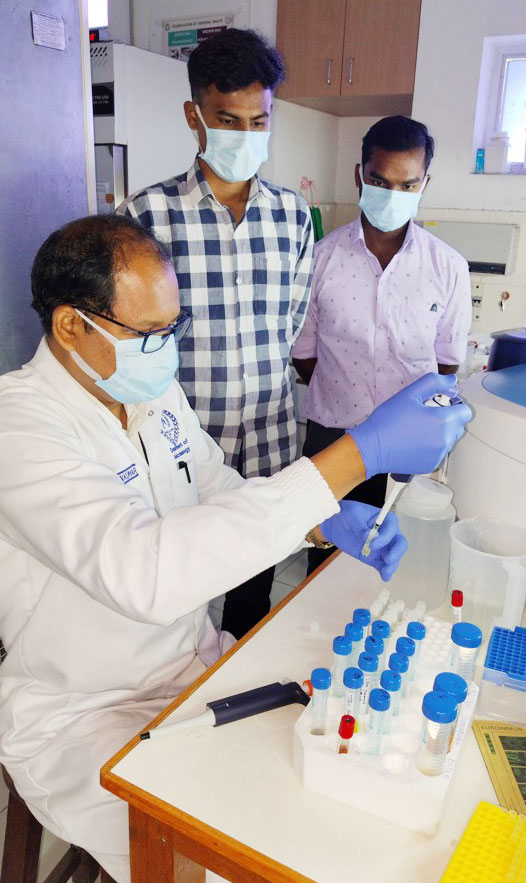
The National Reference Centre for Rickettsial Diseases (NRCRD) proposes the following objectives as part of training.
Training in Diagnosis of Rickettsial Infections & Establish robust Quality Assurance support for rickettsioses.
- In India, the laboratory diagnosis of scrub typhus is heavily dependent on serological tests, with significant lab-to-lab variation.
- Though many labs have the ability to perform molecular assays, very few laboratories offer PCR assays.
- Training and provision of IQC material will enhance lab capability for the diagnosis of rickettsioses.
- Establishing EQAS for rickettsioses will help in national policy and interventions.
- The NRCRD offers regular molecular and serological assays for scrub typhus and spotted fever. Availability of assays for murine typhus and Q fever is in project mode only.
Strategies for National Rickettsial Surveillance
- Though a lot of publications have been generated from India on scrub typhus, there is a dearth of data on spotted fever, murine typhus and Q fever.
- The bulk of papers are case reports on scrub typhus.
- Systematic surveillance has been performed patchily at few centres, and on project basis. There is no sustained hospital-based surveillance (HBS) data,
- The CAR has been testing for scrub typhus since 2005 and for nearly 15 years for spotted fever.
- Initiation of fever surveillance with an aim to identify cases of rickettsioses will provide important information on the disease's burden.
- A sustained implementation of HBS will inform about hotspots and associated risk factors, in addition to health-seeking behaviour.
- This will, in turn, provide information to effectively devise health education modules for prevention and control among those at risk (risk groups).
- Vector surveillance will be the next logical step for better understanding the transmission dynamics involved, including vector capacity and abundance.
Combined with investigation of the role of climate in vector abundance and disease prevalence, suitable advisories can be formulated and the general public made aware of the risks. - This will be useful in lowering the disease burden in the groups at risk. Currently, such data and information are not available, but can be mitigated by the implementation of a National Rickettsial Surveillance Programme.
Expected outcomes:
- Information on the most effective assay for serological and molecular diagnosis for different resource levels.
- Knowledge of the biology of Indian rickettsial agents, including genomic data.
- Infrastructure development:
- Training of Trainers: Availability of a group of well-trained personnel in rickettsial diagnosis
- Upgradation of rickettsial diagnostic facilities, especially capable of providing rapid and accurate results
- Establishment of a National rickettsial surveillance network,
- Will provide hospital-based disease burden data
- This data will be used for risk prediction using artificial intelligence and development of a health education module for prevention and control.
- Generation of robust data, which will aid in policy formulation and the appropriate allocation of resources.